
Hidalgo County City Directory Holdings
The strongest verified run is the Texas State Library and Archives Commission listing for McAllen. It identifies volumes for 1966, 1968, 1970, 1972, 1973, 1978, a 1978 supplement, and 1982. Those dates establish holdings, not a claim that every neighborhood or person appears in every edition. The guide does not state a publisher for each volume or whether each volume is complete, so inspect the title page and publication notes before treating any field as a full household roster.
| Collection | Years identified | Where held or listed | Access route |
|---|---|---|---|
| McAllen city-directory holdings | 1966, 1968, 1970, 1972, 1973, 1978, 1978 supplement, 1982 | Texas State Library and Archives Commission | Confirm the individual volume through the holdings guide |
| Wilmot McAllen directory | 1951-52 | San Antonio Genealogical & Historical Society catalog | Catalog lead for a library or interlibrary request |
| Wilmot Edinburg & Elsa directory | 1962 | San Antonio Genealogical & Historical Society catalog | Catalog lead, not verified digitized pages |
| Newspapers, yearbooks, local-history collections | Availability varies | McAllen Public Library eBranch | Some resources require library computers or network access |
Start with the town named in the source. McAllen, Edinburg, and Elsa volumes document different local slices. A missing year is a gap in the known shelf, not evidence that a household was absent from Hidalgo County.
Hidalgo County City Directory Years at TSL
The Texas State Library city-directory guide is the cleanest starting point for the McAllen run because it gives an exact year list. The 1978 supplement matters. It should be treated as an addition to that year rather than silently folded into a regular annual volume. For earlier leads, the San Antonio catalog identifies B. A. Wilmot's McAllen, Texas City Directory for 1951-52 and Wilmot Directory Service's Edinburg & Elsa Texas City Directory for 1962. Catalog listings identify editions to request; they do not guarantee searchable scans.
The gap between known editions is part of the result. A household listed in 1951-52 and again in 1962 may have moved, changed its spelling, or simply fallen outside an unlocated volume. Search the original city name, the directory year, and the address separately. Then keep the library or catalog citation with the lead. This avoids turning a useful shelf list into an invented continuous run for McAllen, Edinburg, Elsa, or the county as a whole.
The state holdings page records the McAllen directory years before any image is used as a research lead.
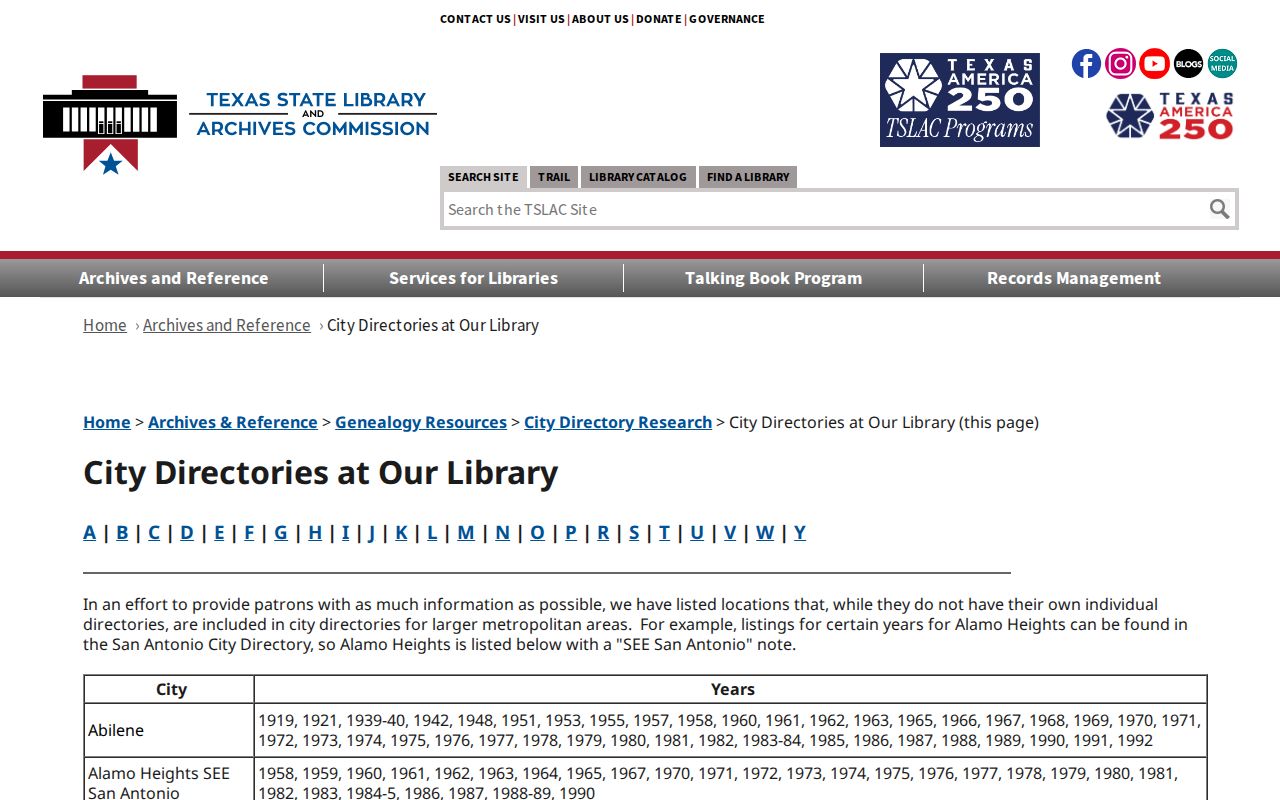
Use the holding list to request the right year, then read the volume itself for its title, abbreviations, and coverage notes. The separate San Antonio genealogical catalog is useful when the search begins before the TSL McAllen run.
Hidalgo County Library Research Channel
McAllen Public Library eBranch links readers to The Monitor, the McAllen Daily Monitor Historical Archive, Brownsville Herald, Valley Morning Star, Ancestry Library Edition, local-history collections, and local high-school yearbooks. Conditions differ by resource. Several databases are available only on library computers or devices connected to the library network. The main library is at 4001 N 23rd Street in McAllen, and its reference contact is referencelibrarian@mcallen.net.
The library's genealogy and reference materials are non-circulating and used in house. Its free obituary research is a useful archive route: provide the requester's name, phone, and email along with the deceased person's name, death date, and city or county of death. Staff search archived Monitor microfilm, which is more focused than asking them to solve an unspecified name match.
The McAllen library services page is the source for this reference and genealogy channel.

A dated directory entry can be paired with a newspaper or obituary request to test a move, a death, or a family connection without treating the directory alone as final proof.
Hidalgo County Archives and Scans
UTRGV Special Collections and Archives holds regional history, local authors, business, genealogy, politics, civil-rights, and manuscript material that will not appear in a printed directory. Its Edinburg reading room is University Library ELIBR 4.100, 1201 W University Drive, with Monday through Friday hours of 8 a.m. to 5 p.m. Appointments are recommended. The archive can be approached through its reading room or through ArchivesSpace, which provides a route to collection descriptions.
The digitized Hidalgo County Historical Collection includes material from the Historical Commission, John Closner, and Falcón family collections. One visible item is a Jackson-to-Closner warranty deed for Porción 71 with a county-court signature and embossed seal. It is a contextual image and legal-description lead, not a household listing.
The Hidalgo County Historical Commission Portal collection offers another archive starting point.
The Portal showed 23 visible items when inspected. That small inventory is a curated sample, so pair it with UTRGV, the TSL guide, and library newspapers rather than treating it as a complete county archive.
Hidalgo County Maps Beside Directories
A directory gives a name and an address. A map can supply the street setting. The Library of Congress has a six-sheet Mission Sanborn edition dated June 1933 to May 1949 and an eight-sheet McAllen edition dated March 1925. These are map records, not resident rolls. They can show a building's footprint, use, construction, nearby streets, and edition date.
Record the sheet number, edition, and surrounding street names before comparing an address. A map can show a structure without naming its occupants, while a directory can name an occupant without showing the building. The two sources answer different parts of the same historical question.
Note: A street match should be kept as a map reference until the directory year, image, and other dated evidence agree.
Reading a Hidalgo County City Directory
Read every entry as the edition printed it. The known Hidalgo County volumes may list a household head, spouse, occupation, or business address, depending on the edition. Do not invent a relationship, ownership status, or street section that the title page and abbreviation key do not support. Capture the spelling, initials, city, year, and page before normalizing a surname or joining it to another record.
| Name and initials | Preserve the printed form. Initials and compound surnames may be the best clue to a later catalog search. |
|---|---|
| Household detail | A spouse or household reference may appear, but only where that edition actually prints one. |
| Occupation or business | Some entries include work or business information. Treat it as an edition-specific clue. |
| Address | Record whether the printed address is residential or business-related before comparing it to a map. |
| Marks and abbreviations | Use the volume's own key. Do not assume a symbol proves ownership or a residence status. |
- Criss-cross directory
- A street-ordered section, if a particular edition contains one. No verified local holding should be assumed from the alphabetical section alone.
- Householder index
- An index organized around the person or household rather than a street. Its scope depends on the edition.
- Abbreviation key
- The explanation printed in the volume for its shortened terms and marks. Photograph or transcribe it with the entry.
Hidalgo County Directory Index Quirk
Hidalgo County archival indexing is not always intuitive. UTRGV's marks-and-brands collection identifies a founding-period gap from 1852 through 1866 and notes a surname sorting quirk: "de la Garza" is indexed under Garza. That is not a rule for every directory, but it is a strong reminder to search visible spellings and plausible word order before deciding a surname is missing.
For a ranching family, a mark or brand entry may connect a surname to a date and volume when a city listing does not. The collection's entry for "Acosta, Julian; Vol C:5, 1914" is a reproducible index example, not proof about similarly named people. Read the original item or its full catalog description before drawing a family conclusion.
Tracing Hidalgo County Directory Households
A sound household trail moves through dates rather than jumping from one name hit to a conclusion. Begin with the exact city and year, then keep the entry's original spelling and address. The sequence can bridge the long gaps between federal census years, but each directory still needs an independent check. Library newspaper access, UTRGV manuscripts, a deed, a probate lead, or a vital-record verification may supply that check.
- Find the person in the directory year closest to the event or residence period being researched.
- Copy the name, initials, address, page, city, and all edition-specific details exactly as printed.
- Check the next known volume for the same spelling and address, then search plausible surname order changes separately.
- Place the dated entries beside the relevant census decade, newspaper notice, map sheet, deed, or archive description.
- Record an absence as not located in that volume, not as proof that the household left Hidalgo County.
When the purpose changes from a historical household to confirmation of a current record, use the official-source workflow on the Hidalgo County resident lookup page. A historic address can be a valuable anchor, but it should not be treated as a current contact detail.
Hidalgo County Directory Limits
Reverse or criss-cross directories were not verified as holdings at TSL, McAllen Public Library, or UTRGV. A reader can look for a street-address section in a specific volume, but should not assume that the regular alphabetical listing contains one. Likewise, no named standalone obituary index was located. The verified route is McAllen Public Library's Monitor microfilm service, using the focused request details it requires.
Sekula Memorial Library in Edinburg provides another catalog route at 1906 S Closner Boulevard, but a dedicated genealogy collection or digitized directory list was not verified in the research. The Hidalgo FamilySearch Center can help with catalogs and microfilm technology, subject to the availability rules for a particular image. These channels expand a search without turning an unverified catalog lead into a claimed holding.
Note: A city directory is a dated research source, so current names, addresses, and relationships require a newer source and careful verification.