
Hidalgo County Previous Residents by Era
One address can produce several different kinds of evidence. The current property layer identifies a parcel and an owner of record. A recorded deed identifies parties to a transaction. A dated directory can place a household at an address for that edition only. For Hidalgo County previous residents, retain the source date, record number, spelling, and address form with each result. That small discipline prevents a tax name, an old directory listing, and a modern map label from being treated as one claim.
| Source | Years | Where | What |
|---|---|---|---|
| Official Records Search | Current portal, certified 08/24/2026; earliest online date not stated | Hidalgo County Clerk online | Recorded-instrument index by party, subdivision, document, or date |
| HCAD, tax, and GIS | Current views; historical online coverage not stated | Official appraisal, tax, and ArcGIS routes | Parcel, account, address, taxing-jurisdiction, and mapped context |
| TSL deed records | 1852-1888 | UTRGV microfilm reels 1017237-1017250 | Direct and reverse indexes plus deed volumes A-D |
| Spanish deeds and supplement | 1854-1896; 1880-1912 | TSL reel 1017249 at UTRGV | Transcribed deeds and related instruments such as mortgages or powers of attorney |
| McAllen and Valley directories | 1951-52, 1962, and selected 1966-1982 McAllen years | Library catalogs and TSL holdings | Dated household and street-address leads, subject to edition limits |
Start with the parcel for a recent question. Start with the TSL series or a dated directory for an older one. Neither route proves continuous occupancy. It only establishes what the specific record says at its own date.
Hidalgo County Previous Residents Start with a Parcel
The Hidalgo County Appraisal District property route, the county tax portal, and the official ArcGIS layers answer related but different questions. HCAD is the appraisal route. The tax portal can search by owner, property address, account number, CAD reference number, or fiduciary number. GIS supplies address-point, parcel, and city-limit context. Use them together to capture the current account, property location, subdivision, lot or block, and legal description before opening the deed index.
A mailing address is not automatically the property location, and neither is the legal description. Hidalgo County's address-correction form separates those fields, along with account number, tax year, seller, purchase date, and deed attachment. A porción, survey, acreage description, or later lot and block can carry the trail through a change in street naming. Preserve the source's original wording beside a normalized address.
Record trail: address → parcel or account → legal description → recorded instrument → earlier grantor or grantee → dated household source.
Note: The appraisal, tax, deed, and GIS layers have different purposes and update cycles, so a mismatch is a prompt to verify, not proof that one record is wrong.
Trace a Hidalgo County Deed Chain Backward
The Hidalgo County Official Records Search accepts a grantor or grantee, subdivision, document type, document number, and recorded-date range. It also offers index-only and OCR full-text searching. An index hit is a lead, not a title conclusion. Record the document number or volume and page, the instrument type, the recorded date, and the legal description before moving to the next transaction.
- Save the current parcel or account details and the legal description from the official property layers.
- Search the current owner as grantee to locate the instrument by which that party acquired an interest.
- Record the seller, who is the grantor on that instrument, then search that seller as grantee to locate the earlier acquisition.
- Repeat the sequence by document date, checking each transition against the HCAD and tax views rather than assuming the address alone stayed constant.
- When the online trail reaches an unstated cutoff, use the TSL guide and UTRGV microfilm for the appropriate index, volume, or reel.
- Grantor
- The party transferring an interest in a recorded instrument.
- Grantee
- The party receiving that interest. In a backward search, a prior seller may appear as grantee on an earlier record.
- Chain of title
- A dated sequence of recorded transfers tied to the same legal parcel, not simply a list of similar street addresses.
- Legal description
- The lot, block, survey, porción, or other property wording used to connect a deed to land when an address is incomplete or later changed.
Hidalgo County Previous Residents and Index Direction
The historical route is unusually specific. The Texas State Library and Archives Commission guide places Hidalgo deed records for 1852-1888 at UTRGV, with direct and reverse indexes on reels 1017237-1017246 and deed volumes A-D on reels 1017247-1017250. Maps are on reel 1017251. The guide also lists the 1880-1912 deed supplement and Spanish-transcribed deeds for 1854-1896 on reel 1017249.
The useful insider step is choosing the index direction before reading a volume. When a known party acquired the parcel, use the grantee side to find that purchase. When a party conveyed it, use the grantor side to find the transfer out. Copy the volume, page, reel, spelling, and legal description at every turn. The guide's gaps and unindexed series matter as much as its dates.
The County Clerk forms page is a second access channel when an index lead needs an official request or a redaction question needs the Clerk's process.
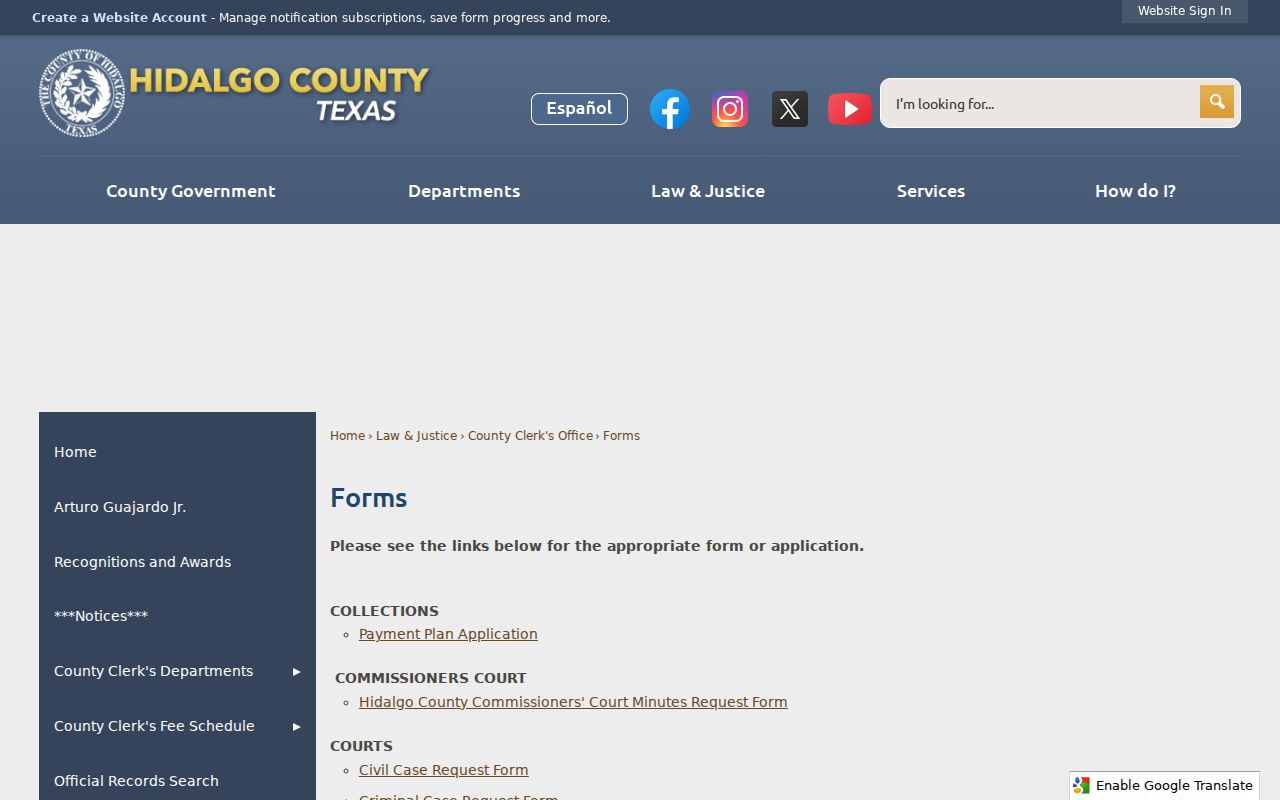
The forms screen reinforces that an online result and a record request are separate steps. Clerk staff can provide filing mechanics, but the form page says they cannot provide legal advice.
Hidalgo County Previous Residents Before Online Records
The portal's certification through August 24, 2026 is a current-status marker, not a promise that every older Hidalgo County deed is online. Its earliest index or image date was not stated in the inspected source. Treat the web portal and the 1852 microfilm series as separate channels. A failed web search does not resolve the historical question.
For early property research, the TSL guide also identifies tax rolls from 1852-1910, probate minutes from 1852-1911 with a case-paper index, marriage records from 1852-1888, and survey material from the late nineteenth and early twentieth centuries. Those series can supply context for a parcel or family, but an unindexed minute book should not be described as a name-searchable database. Ask for the relevant reel, volume, date window, and index direction.
Note: Keep the modern portal's certification date with the search notes, but do not use it as an inferred start date for online historical coverage.
Hidalgo County Past Households in Directory Dates
Ownership and occupancy are different facts. The Texas State Library directory guide lists McAllen holdings for 1966, 1968, 1970, 1972, 1973, 1978, a 1978 supplement, and 1982. The San Antonio Genealogical & Historical Society catalog identifies Wilmot's McAllen, Texas City Directory 1951-52 and an Edinburg & Elsa Texas City Directory for 1962. These titles identify editions to request; they do not establish complete coverage for every Hidalgo County community.
No named reverse or criss-cross directory holding was verified in the local or institutional catalogs reviewed. For a past-resident search, inspect the individual edition for an address section rather than assuming it has one. The wider holdings and access routes are collected on the Hidalgo County city directories page.
- Choose a directory edition nearest to the period being researched and note its city, year, and page.
- Copy the household spelling, initials, address, and any field that the edition actually prints.
- Compare the listing with a deed, newspaper, obituary, yearbook, probate file, or archive item that agrees on date and place.
- Describe the result as a dated directory listing, not as proof that the household remained there before or after that edition.
Note: Treat a directory entry as a snapshot from its stated edition, especially when city coverage or address sections are uncertain.
Hidalgo County Previous Residents in Maps and Archives
Maps can date the built setting without naming the people in it. The Library of Congress describes an eight-sheet McAllen Sanborn map from March 1925 and a six-sheet Mission edition dated June 1933-May 1949. A sheet can show a structure, use, construction material, and nearby street context. It cannot prove who lived in the building. Record the edition, sheet number, and surrounding street names before comparing it with a directory or deed.
The McAllen Public Library eBranch lists local newspaper resources, the McAllen Daily Monitor Historical Archive, local-history collections, in-library Ancestry Library access, and selected yearbooks. The library also offers free Monitor microfilm obituary research when a requester provides the deceased person's name, death date, and city or county of death.

That library route adds a dated household or obituary lead to the property trail without turning a map or an archive listing into a current address claim.
Hidalgo County House History and the 1908 Move
A common mistake is expecting every old Hidalgo County record to point to the same courthouse context as a modern search. The Texas Historical Commission record for the Old Hidalgo County Courthouse dates the building at First and Flora in Hidalgo to 1886-1908. The county seat then moved to Chapin, later Edinburg. An older deed, minute, or map can therefore use Hidalgo, Edinburgh or Edinburg, a precinct, a survey, or a Spanish place name.
This is a jurisdiction clue, not proof of a street renumbering or a new parcel. No official countywide historical address-equivalency table or year-specific renumbering schedule was located. Compare the original legal description, plat, directory edition, and map date instead of inventing a modern address match.
Confirming Hidalgo County Previous Resident Leads
Use modest labels for each result. A person named as grantee in a deed is a recorded transaction party. A person in a directory is listed for that edition. A person shown on an appraisal or tax record is the name used by that system at the time displayed. The strongest connection uses at least two independent anchors, such as a legal description plus document number, or an address plus matching date and household detail.
Spellings deserve the same care. Hidalgo County research may include Spanish-transcribed deeds, compound surnames, old abbreviations, and a transition from acreage to a subdivision lot. Preserve the visible spelling until an original image or catalog entry supports a normalization. When two candidates fit, leave the result unresolved rather than assigning a house history to the wrong family.
Lawful Limits for Hidalgo County Past Residents
House-history research is most useful for family history, an estate or heir question, historic preservation, or personal curiosity about a property. It is not a reason to reconstruct a protected current address. Texas voter confidentiality rules and the DPS Address Confidentiality Program can suppress or substitute an address for eligible people. Do not combine old deeds, tax records, directories, or map layers to defeat an omission.
Lawful use. Use Hidalgo County past-resident records to understand a property or a dated historical connection. Do not use them to watch, harass, intimidate, or harm a living person.
For a public record that needs correction or redaction, use the responsible agency's official route. The County Clerk forms page includes a Social Security number redaction request, while its staff cannot provide individualized legal advice.